
Blog / Cybersecurity Careers: Jobs to Explore
Sundance Blog
Cybersecurity Careers: Jobs to Explore

Cybersecurity Diploma
Employment Opportunities:
- Cybersecurity Specialist
- Information Technology Security Specialist
- Cybersecurity Analyst
- Network Security Specialist
Cybersecurity Learn more
Student aid eligible
13 November 2026 | Author: Nick Greene
| Read Time:
Quick Answer
Cybersecurity professionals protect the systems, networks, and information organizations rely on. Depending on their role, they may investigate security threats, manage security tools, control network access, or secure IT infrastructure.
Explore the career-focused training, market demand, and four cybersecurity roles you could pursue with Sundance College's 50-week Cybersecurity diploma program:
- Cybersecurity Specialist
- Information Technology Security Specialist
- Cybersecurity Analyst
- Network Security Specialist
Table of Contents
Businesses rely on digital systems to store sensitive information, communicate with customers, and manage daily operations. Keeping those systems secure requires people who understand how technology works and how to defend against cyber threats.
Cybersecurity professionals help organizations protect their networks, devices, software, and information. Their work covers several areas, from investigating suspicious activity to securing the systems employees use every day.
The field includes different roles, each with its own focus. Here’s a closer look at where these professionals work, four positions to consider, and the training that prepares you for cybersecurity work.
Where Do Cybersecurity Professionals Work?

Cybersecurity is relevant in any organization that uses digital systems or handles sensitive information. That includes businesses of all sizes and across many industries. For instance:
- Banks and financial institutions need secure systems to protect customer accounts and transactions.
- Hospitals and healthcare organizations must protect patient information and the technology used to deliver care.
- Government departments rely on cybersecurity teams to protect public information and essential services.
- Technology companies, retailers, educational institutions, and consulting firms need security professionals too.
Cybersecurity professionals work in various settings. Some are part of an organization’s IT department while others work for cybersecurity firms that provide security services to multiple clients.
The work can also vary by employer. One professional might monitor security alerts in a hospital. Another might manage access to a government network or help a technology company secure its servers.
“When you understand the technology behind an environment, it becomes much easier to identify vulnerabilities, investigate threats, and develop effective security solutions.”
– Amrinder S., Technology Instructor, Sundance College
Is Cybersecurity in Demand?
Yes, cybersecurity is in demand. As businesses, governments and other organizations become increasingly dependent on digital technology, the need to protect their systems, networks and sensitive information continues to grow.
Cybersecurity professionals play a critical role in protecting organizations from cyberattacks, preventing data breaches and keeping essential systems secure. Their skills are needed across a wide range of industries, including:
- Financial services
- Government
- Healthcare
- Technology
- Telecommunications
Yet organizations are struggling to find people with the right skills. According to the World Economic Forum’s Global Cybersecurity Outlook 2026, nearly 1 in 3 organizations surveyed reported a shortage of cybersecurity skills and expertise.
For those looking to break into cybersecurity, formal education provides the technical knowledge, hands-on training and practical experience needed to start a career in the field.
Four Cybersecurity Jobs to Consider

Protecting an organization’s technology involves several kinds of work. Cybersecurity professionals monitor threats, secure IT systems, and manage network protection.
“Entry-level IT positions such as IT Support Technician can provide valuable hands-on experience and help build the technical skills needed to advance in cybersecurity.”
– Amrinder S., Technology Instructor
Here are four roles that show the range of work available in this field.
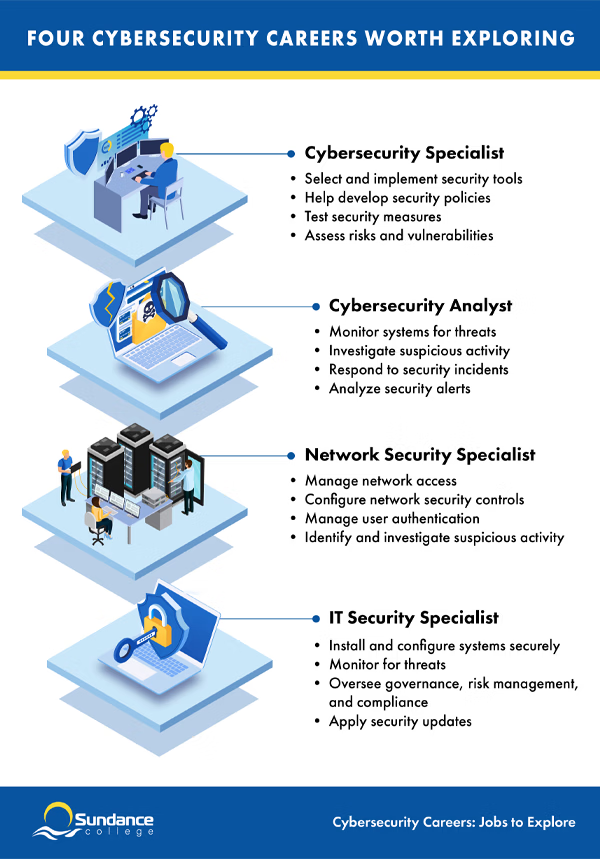
Cybersecurity Specialist
Cybersecurity specialists protect organizations’ digital systems and information. Their work includes reviewing security measures, identifying vulnerabilities, and preventing unauthorized access.
They also help establish security policies and procedures. When an organization identifies a weakness, specialists assess the risk and recommend ways to address it.
The role calls for a strong understanding of IT systems and security practices. Entry-level cybersecurity specialists may handle monitoring security alerts, responding to incidents, maintaining security tools, documentation, and user support.
Information Technology Security Specialist
IT Security Specialists help keep an organization’s IT systems and devices secure. Their work includes installing and configuring computers, servers, software, and other connected devices.
They keep their organization’s digital environment safe through patches, processes, and tools. They also review security controls, governance, risk management, and compliance.
This role connects IT knowledge with security. Understanding operating systems, hardware, and networks helps professionals to identify weaknesses and maintain secure environments.
Entry-level IT Security Specialists often help manage IT systems and provide technical support.
Cybersecurity Analyst
Cybersecurity analysts identify and investigate potential cyber threats by monitoring systems and reviewing security alerts.
They’re responsible for examining system activity, identifying vulnerabilities, and maintaining compliance. They also work with other cybersecurity and IT professionals to manage security tools, processes, and policies.
Entry-level analysts usually handle monitoring, investigation, and response.
Network Security Specialist
Network Security Specialists focus on protecting the networks that connect an organization’s devices and systems. They keep network activity secure by preventing unauthorized access and malware installation.
This work includes network monitoring, access, and account management. They also identify weaknesses in network infrastructure and recommend improvements.
Entry-level Network Security Specialists need a strong knowledge of networking including how devices communicate, and how network components work together.
Start Your Cybersecurity Career with Sundance College
A career in cybersecurity starts with understanding the technology you’re working to protect. Sundance College’s 50-week Cybersecurity Diploma program covers the IT and security skills used across the field. The hands-on program includes a 7-week practicum opportunity to prepare you with practical skills to pursue careers in cybersecurity.
The program covers key topics such as:
- Security+
- Ethical Hacking
- Network+
- CCNA Routing & Switching
- Cybersecurity Analysis
- Cloud Security
- Linux Security Fundamentals
- IT Fundamentals
Taught by cybersecurity-experienced instructors, the program teaches you how to identify, investigate, and prevent threats.
You’ll learn how to maintain and protect physical and digital systems including networks, servers, and software platforms. You’ll also develop knowledge to pursue industry certifications such as CompTIA Security+, CompTIA Network+, and CCNA. Sundance College also provides financial support to help you obtain these certifications.
As a Sundance College graduate, you receive lifetime support from our Career Services team to help you with interview prep, resumes, and job search support.
Connect with us today to learn more about how our program prepares you for these cybersecurity careers.
Frequently Asked Questions About Cybersecurity Careers
-
Do I need a degree to work in cybersecurity?
No. Canada recognizes both college diplomas and university degrees as educational pathways to a cybersecurity career.
University degrees typically include additional coursework that is unnecessary for most entry-level cybersecurity roles. Career-focused diplomas provide technical knowledge, practical skills, and hands-on experience in considerably less time.
Sundance College’s 50-week Cybersecurity diploma covers networking, ethical hacking, cybersecurity analysis, and cloud security. It also includes practical work experience.
-
Can I get a cybersecurity job with no experience?
You can begin your career without previous cybersecurity work experience.
However, employers value hands-on skills and practical experience related to work. Sundance College’s 50-week Cybersecurity diploma program provides you with hands-on training and a 7-week practicum opportunity to apply your skills in a real workplace.
-
Can cybersecurity professionals work remotely?
Some cybersecurity positions offer remote or hybrid arrangements. Others require employees to work on site, especially when the role involves specific systems or security requirements.
The arrangement depends on the employer, industry, and responsibilities.
-
How much do cybersecurity professionals earn?
Cybersecurity professionals earn up to $98,134 a year. This depends on your industry, location, and employer.
-
Does cybersecurity require coding skills?
No. The cybersecurity careers that Sundance College’s Cybersecurity Diploma program prepares you for do not require coding or programming skills. Instead, the program focuses on practical, hands-on training in network security, threat detection, ethical hacking, and responding to cyberattacks. You’ll also gain real-world experience through a seven-week practicum.
-
How long does it take to start a cybersecurity career?
You can start a new career in cybersecurity in under a year.
Sundance College’s Cybersecurity diploma program takes only 50 weeks and includes a 7-week practicum. This prepares you with real-world work experience even before graduating.
Subscribe for more career advice
Blog Categories
Share on: