
Blog / What is the STAR Technique? How to Create Strong Interview Answers
Sundance Blog
What is the STAR Technique? How to Create Strong Interview Answers

Explore our Diploma Programs
Fields of Study:
- Business, Hospitality, and Legal
- Health and Human Services
- Technology
Explore our Diploma Programs Learn more
Student aid eligible
26 January 2026 | Author: Vallankan Mendonca
| Read Time:
Quick Answer
The STAR technique is a simple method used to structure your answers to job interview questions. It stands for Situation, Task, Action, and Result, and helps you give clear, organized examples that show how you handled real-life experiences.
Table of Contents
It’s normal to feel anxious during a job interview.
When that happens, it’s easy to talk in circles, lose your point, or skip the details that employers are looking for. The STAR technique keeps your answers organized and easy to share. It works across different fields and helps you present your experience with clarity.
Here’s how it works.
What Does STAR Stand For? Understanding the Framework
The STAR technique is an effective way to prepare your answers for behavioural interview questions. Instead of trying to remember every detail on the spot, you use four steps to share an example of how you handled a situation:
- Situation
- Task
- Action
- Result
Bea Y. and Mariam M. are members of the Career Services team at Sundance College. They regularly provide career support to students through resume assistance, job search techniques, and one-on-one interview preparation.
Bea explains how the STAR technique helps candidates give interviewers a clear picture of their experience.
“STAR helps candidates stay focused on what matters most in an interview. It allows you to clearly explain your responsibility, your actions, and the outcome, so interviewers can see how you handle workplace situations.”
By organizing your experience into Situation, Task, Action, and Result, you make it easier for interviewers to follow your thinking and understand your contribution. That clarity in your answers often makes the difference in a hiring decision.
Breaking Down Each STAR Component
STAR works best when you know what each part should include and how much time to spend on it.
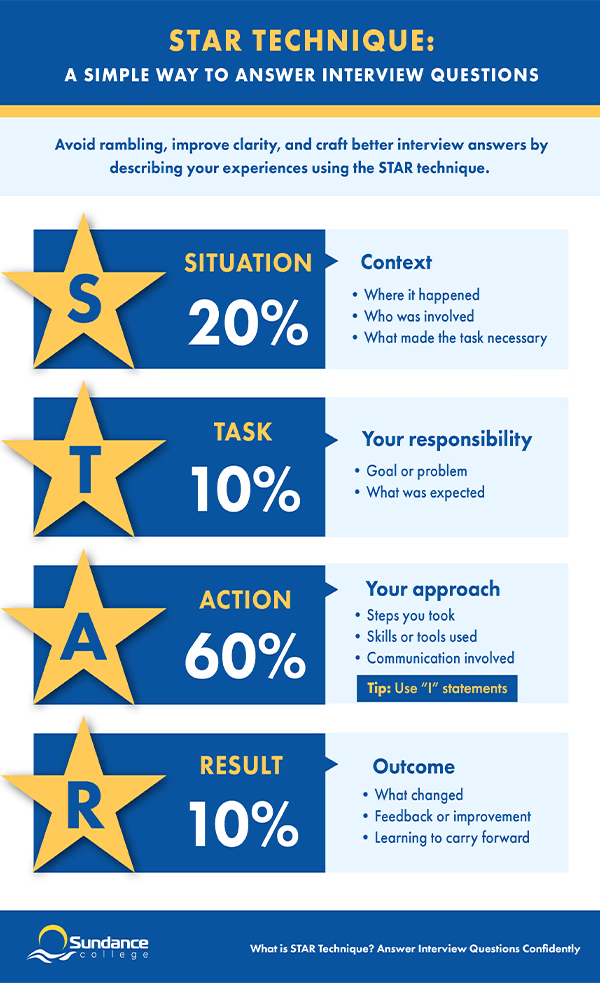
“A general rule of thumb for STAR answers is to spend about 20% on the situation, 10% on the task, 60% on your actions, and 10% on the result.”
This breakdown prevents long setup and keeps the answer centred on what you did.” – Mariam M., Sundance College Career Services
With this balance in mind, each part of STAR serves a clear purpose in building a strong, interview-ready response.
Situation: Setting the Scene (20% of answer)
The Situation is the background to your story. Here you explain where you were, who was involved, and what was going on.
The key thing to keep in mind is that the situation you choose should always be a direct response to the question you’ve been asked. If the interviewer prompts you to tell them about “a time you handled conflict”, the situation you share should clearly involve a moment of conflict. If they ask about teamwork, problem-solving, or time management, your example should reflect that.
Bea recommends keeping the Situation in STAR very brief:
“Keep the situation short and specific. One or two sentences is usually enough. Explain the setting – whether it’s a workplace, classroom, or practicum – and the issue that led to it”
Keeping this section focused helps the interviewer immediately see the connection between their question and your example.
This is where a little preparation can make the whole interview much easier to manage. Having a few situations prepared in advance means you can avoid trying to invent an example on the spot.
Give just enough information at the beginning of your answer to set the scene and provide the necessary context for the interviewer. The goal here is to clearly show that you’ve listened to their prompt, understood what they’re asking for, and have an example to prove it.
When your situation directly reflects the question, it demonstrates strong communication skills, attention to detail, and your ability to respond thoughtfully; soft skills that employers value.
Task: Defining Your Responsibility (10% of answer)
The Task explains what you needed to do in the situation you just laid out. This is the part where you show what was expected from you and why your role mattered in that moment.
While the Situation sets the scene, the Task brings the focus directly on to you. It helps the interviewer understand your level of responsibility before you discuss what you did.
Mariam advises keeping this part clear and focused:
“Focus on what you were responsible for. This could be a problem you were assigned to solve, a goal you were expected to meet, or a duty that was specifically yours.”
Including the Task helps the interviewer understand the scope of your role and the expectations place on you. It shows how you interpreted responsibility, prioritized your work, and recognized what success looked like in that situation. This context makes your actions easier to follow and reinforces your ability to take ownership – a quality that employers look for when hiring.
Action: Describing What You Did (60% of answer)
The Action section is the core of your STAR response. This is where you should spend most of your time and where the interviewer gets the clearest insight into how you work.
The Situation and Task have just set the context, and now the Action will show how you approached that specific problem, made decisions, and carried out your responsibilities.
This is the part of the answer that demonstrates your skills in practice.
“Focus on what you did, even when you worked as part of a team. Walk through the steps you took, the tools or skills you used, and how you communicated with others. Use ‘I’ statements so your contribution is clear, like ‘I spoke with the customer to understand their concern,’ ‘I created a checklist to organize the tasks,’ or ‘I suggested a different way to divide the work.” – Bea Y., Sundance College Career Services
Breaking your actions into clear, logical steps keeps the interviewer on your train of thought. It shows how you solve problems, communicate with others, and adapt as a situation unfolds. These details are crucial when demonstrating how you are likely to approach similar challenges in your new role.
A strong Action section leaves the interviewer with a clear understanding of your, approach, working style, and decision-making abilities. It turns your example into evidence that you can handle responsibility effectively in a real workplace setting.
Result: Sharing Outcomes and Learning (10% of answer)
The Result section of your STAR answer shows what changed because of your actions. This is where you highlight the outcome and learning that came from the experience.
For the Result, Mariam advises to focus on the impact of your actions:
“Explain what changed as a result of your actions. This might include a positive outcome, feedback you received, or what you learned from the experience. Even if the result was mixed, sharing what you would do differently next time shows growth.”
Results help the interviewer understand the value of your contribution. They can now connect your actions to outcomes, demonstrating how your decisions affected people, processes, and/or performance. This reflection also shows self-awareness and a willingness to learn, which are more qualities employers associate with long-term success.
A strong Result section brings your answer full circle. It reinforces why the example was relevant, what it achieved, and how the experience shaped the way you work.
How to Prepare Your STAR Examples (Step-by-Step)
The best STAR answers come from preparation. A bit of planning gives you a library of stories you can adapt to different questions.
1. Identify 8-10 Key Experiences
Start by listing situations from different parts of your life where you had to respond, solve, organize, support, or deal with pressure.
Bea emphasizes how the best STAR examples usually come from everyday situations:
“Examples from school, particularly practicums, are excellent experiences to draw from. Family, or community involvement can also make for be strong STAR stories. Use these instances to show how you handled conflict, met deadlines, supported others, or adjusted quickly under pressure.”
Identifying these situations ahead of time allows you to deliver a standout answer on interview day.
2. Write Out Your STAR Stories
Once you have identified your key experiences, write them down.
Mariam shares how to write STAR stories effectively:
“Write each STAR story as a short outline. Keep the situation and task brief, list your actions clearly, and finish with the result. Putting it on paper helps you organize your thinking and decide which details belong in your answer.”
Having these notes in place makes your examples easier to review, practice, and explain during the interview.

3. Practice Out Loud
Practicing your STAR answers out loud will help you improve the way they come across in a real interview.
Bea emphasizes how practice helps improve responses:
“When you hear your answers out loud, you notice when explanations drift, background runs too long, or actions are not clear enough. That gives you a chance to refine your response before the interview.”
Saying your answers out loud helps you spot issues early and prepare your best response for the interview.
Using the STAR Technique in Different Career Fields
Seeing the STAR technique in action can make it easier to apply it to your own experiences. Here is an example of how to answer the question, “How has your training prepared you for this position?” across different fields.
Healthcare STAR Example
Using the STAR technique when asked about your training in a pharmacy assistant interview:
Situation
“When I was working in home care, medications for several clients were arriving at our facility. Some coworkers were unsure how they should be handled or stored because the medications were new to them.”
Task
“I needed to make sure everyone understood the correct steps, so medications were handled safely and client care stayed on track.”
Action
“I used what I learned in my Pharmacy Assistant diploma program. That included the KROLL system and proper medication handling. I explained which medications had to be refrigerated, which were light sensitive, and how the process works from the prescriber to the pharmacy to the patient. When questions came up, I contacted the pharmacist and shared the answers with my team.”
Result
“When the Pharmacist reviewed how we had stored the medication, she was impressed that it was all in the correct locations.”
Graduate Spotlight
This was Edel U.’s experience as a Sundance College Pharmacy Assistant graduate. Her training helped her understand medication procedures, support her coworkers with accurate information, and grow successfully in her new career.
To learn more about how the Pharmacy Assistant diploma program can prepare you for work in healthcare, contact an admissions advisor today.
Business STAR Example
Using the STAR technique when asked about your training in an accounting interview:
Situation
“During my practicum at an accounting firm, a full-time colleague asked for help with a tax return they were unsure how to complete. It was tax season, so we had lots of files to be completed accurately and quickly.”
Task
“I needed to review the return, answer my colleague’s question, and guide the next steps without slowing the team down.”
Action
“I used what I learned in the tax courses in my Accounting, Tax, and Payroll program. I went through the details, confirmed how the information should be reported, and explained the reasoning so my colleague understood how to handle similar files.”
Result
“The return was finished correctly that day, and the team recognized my knowledge about complex tax situations. That experience led to a permanent position after graduation.”
Graduate Spotlight
This was Tamara M.’s experience as a graduate of Sundance College’s Commerce: Accounting, Tax, and Payroll diploma program. The practicum work she completed at KSDM LLP led to increased responsibility and a full-time bookkeeping position after graduation.
To learn more about how the Accounting, Tax, and Payroll diploma program can support your path into bookkeeping and tax preparation, contact an admissions advisor today.
Technology STAR Example
Using the STAR technique when asked about your training in a digital marketing job interview:
Situation
“During my practicum, I worked with an online learning company. One of their course pages had lots of visitors, but very few people were signing up.”
Task
“My supervisor asked me to use Google Analytics to see where people were dropping off.”
Action
“I used the Google Analytics skills I learned in my Digital Marketing & Social Media Management diploma program to review how visitors were moving through the page.
I noticed that most traffic was coming from mobile, and people were leaving before they reached the sign-up button.
I recommended a few mobile updates, like moving the most important details higher up and making the sign-up button easier to spot.”
Result
“After the update, the page performed better, and the team used my recommendations as a checklist for future page updates.”
Graduate Spotlight
This was Ahmed M.’s experience as a Sundance College Digital Marketing and Social Media Management graduate. The skills he applied during his practicum allowed him to take on real projects, earn a part time role, and step into a digital coordinator position soon after.
To learn more about how the Digital Marketing & Social Media Management diploma program can help you build real workplace skills, contact an admissions advisor today.
Common STAR Technique Mistakes to Avoid
When you work on your STAR stories, you may notice a few habits that make your answers less effective. Being aware of them now makes it easier to avoid them on interview day.
- You may give too much background
It’s easy to replay the whole situation, especially if a lot happened. Interviewers only need the part that sets up your story. A short, focused setup works best. - You may focus on the team instead of yourself
If you worked with others, you might slip into “we” instead of “I.” STAR answers highlight your thinking and your actions, so keep the focus on what you did. - You may rush through the Action
This is the most important part. It shows how you handled the situation and why you took certain steps. Slow down here and walk the interviewer through your decisions. - You may forget the Result
Your answer needs a clear finish. Even one line about the outcome, feedback, or what you learned helps complete the story. - You may rely on memory instead of preparation
Thinking of examples on the spot can make you ramble. Preparing a few STAR stories ahead of time helps you stay steady, focused, and confident.
Avoiding these mistakes keeps your answers sharp and centered on you. With your STAR examples prepared, it becomes easier to communicate your strengths and the value you bring.
How Sundance College Helps Students Prepare for Job Interviews
Sundance College diploma programs prepare you for in-demand fields in under a year. Learn industry processes, workplace software, and practical skills used every day on the job. After completing your coursework, there is a practicum opportunity in your field. This gives you the chance to apply what you’ve learned, connect with employers, and build experience you can talk about in interviews.
Whether that experience involves working against a deadline, collaborating with a team, or solving a problem, you’ll have strong STAR examples you can walk an interviewer through.
You also have lifetime access to our dedicated Career Services team as part of your diploma program, which offers support with interviews, résumés, and job searches.
This combination of hands-on training, practicum experience, and ongoing support means you can walk into interviews with well-prepared examples, strong answers, and valuable experience to back them up.
To get started, contact an admissions advisor today.
Frequently Asked Questions (FAQs)
-
How can I use STAR answers if I don’t have work experience?
You can still give strong STAR answers. Draw from school projects, practicums, community involvement, or responsibilities at home. Interviewers care about how you think and respond, not here the example came from.
-
How long should my STAR answers be?
Aim for about one to two minutes. Keep the Situation and Task brief, spend most of your time on the Action, and end with a clear Result.
-
Can I use the same example for multiple STAR questions?
Yes. One experience can fit several topics such as teamwork, problem-solving, communication, or handling pressure. Focus on the part of the story that matches the question.
-
Is the STAR technique only for behavioural interviews?
While commonly used for behavioural questions that generally start with the phrase “tell me about a time you”, the STAR technique can be used anytime you need to explain how you handled a situation.
-
Should I memorize my STAR answers word-for-word?
No. Memorizing can make you sound stiff. Know your key points instead. This keeps you natural and helps you stay calm.
-
How do I practice the STAR technique effectively?
After you’ve chosen 8 or 10 examples to share and written your STAR stories, say your answers out loud. This helps you hear what makes sense, what feels too long, and where you can be more specific. A few run-throughs are enough to make the stories feel natural.
Subscribe for more career advice
Blog Categories
Share on: