
Blog / General Business Management Job Interview Questions and Answers Guide
Sundance Blog
General Business Management Job Interview Questions and Answers Guide

General Business Management Diploma
Employment Opportunities:
- Entrepreneurship
- Administrative Assistant
- Retail Store Supervisor
- General Business Administration
General Business Management Learn more
Student aid eligible
16 March 2026 | Author: Vallankan Mendonca
| Read Time:
Quick Answer
General business management interviews focus on your knowledge of core functions like marketing and human resources, as well as your skills with common technology. Organization, communication, teamwork, and problem-solving skills are also important. Employers often expect you to share examples that show how you work. Answer effectively using the STAR method (Situation, Task, Action, Result) and share experiences from your hands-on training and practicum experience.
Table of Contents
- Know the Role You’re Interviewing For
- Common Business Management Interview Questions
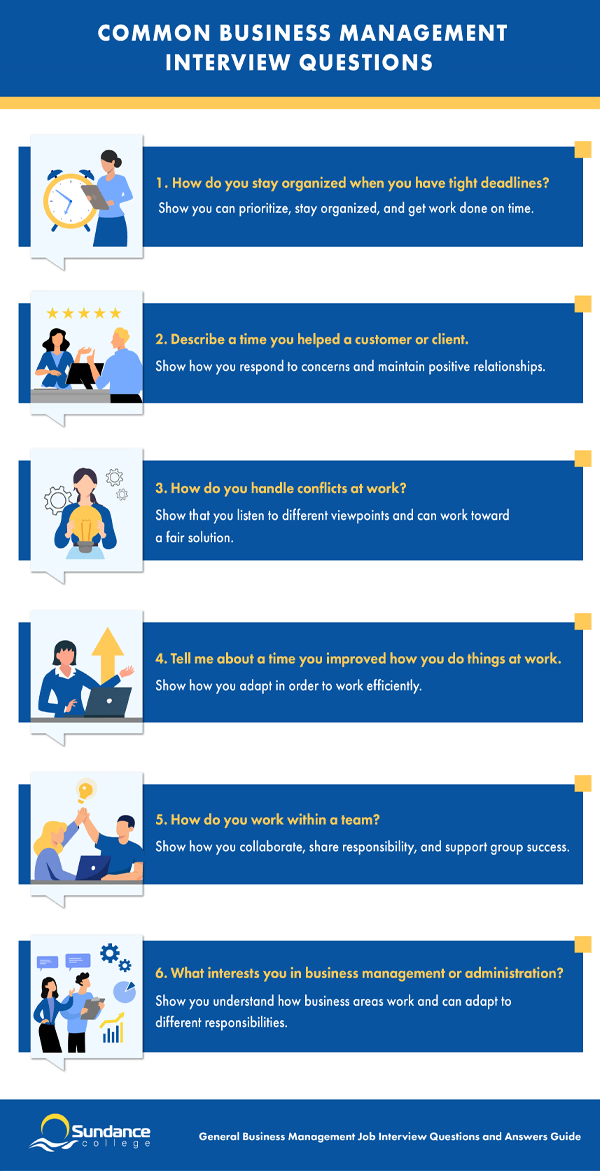
- How do you stay organized when you have tight deadlines?
- Describe a time you helped a customer or client.
- How do you handle conflicts at work?
- Tell me about a time you improved how you do things at work.
- How do you work within a team?
- What interests you about business management or administration?
- How does the Sundance College diploma program prepare you for this role?
- FAQs
Stand out during your business management interviews by walking an employer through experiences you’ve handled, in a class project or real-world experience. Explain how you used technology effectively, managed competing priorities, solved problems, worked with others, and adapted when things changed.
Here’s how you can prepare and perform your best in your business management interview.
Know the Role You’re Interviewing For
The first step in preparing for a business management interview is to understand the role you’re applying for. This makes it easier to connect your skills to what the employer is looking for and give effective answers.
Bea Y. is part of the Career Services team at Sundance College. She supports students and graduates with résumés, interview prep, and job search. She advises students to investigate the company they’re interviewing with beforehand.
“Don’t stop at reading the job posting. Take time to explore the company’s website and LinkedIn page so you understand their priorities. This helps you tailor your answers to what they need.”
Understand what matters to the employer so you can explain where you fit and the value you bring.
Common Business Management Interview Questions
When you interview for a business management role, employers want to see how you will contribute to their organization.
“Interviewers pay attention to how you communicate, stay organized, and handle responsibility in everyday situations.
That’s why examples from your coursework and practicum matter. They show what you’ve learned and how you can apply it at work. For recent graduates, it’s a way to highlight relevant experience.” – Bea Y., Career Services, Sundance College.
Employers value candidates who show they are ready to take on workplace responsibilities. When your answers reflect that readiness, you set yourself apart.
Let’s look at some interview questions you can expect.
How do you stay organized when you have tight deadlines?
Competing priorities are common in the workplace. Show interviewers that you can identify what’s most important and get things done.
Sample Answer:
“During my practicum at a small business, I had to update several customer accounts before a meeting later that week.
To stay organized, I reviewed my tasks and arranged them by priority so I could see what needed attention first. I also set aside time in my Outlook calendar to complete the updates.
By the time of the meeting, all the accounts were updated and ready for the team to review.”
Describe a time you helped a customer or client.
Customer service is about understanding people’s needs and helping them find solutions. Impress interviewers by showing them that you can handle concerns and maintain positive working relationships.
Sample Answer:
“During my practicum at a digital marketing agency, I supported clients by tracking campaigns and sharing updates. When part of a campaign wasn’t ready, the client worried the launch would be delayed.
I checked the campaign schedule and saw we could launch with what we had. I suggested to my supervisor posting what was ready and adding the rest later that day. This gave the team time to finish the rest. The campaign went live as planned, and the client appreciated the quick solution.”
How do you handle conflicts at work?
This question checks if you take initiative and find a fair solution when conflicts arise at work. Use the STAR method for creating an effective response. STAR stands for Situation, Task, Action, and Result. It helps you organize your answer by explaining those four aspects of a workplace experience.
Sample Answer
Situation:
“During my practicum at a small business, another student and I were reviewing job applications. They believed one candidate should move ahead based on their impression of the résumé. I noticed the candidate’s experience did not match several key requirements listed in the job posting, which led to a disagreement.”
Task:
“We needed agree on a recommendation before sending our feedback to the HR manager.”
Action:
“I thought back to what I learned about conflict management in my General Business Management diploma program. I suggested we review the job posting and candidate together. We compared the résumé with the required skills. I walked through the main requirements for the position and showed how the candidate’s experience matched some areas but missed others.”
Result:
“After reviewing the requirements together, the other student agreed with the evaluation. We then shared our recommendation with the HR manager.”
Tell me about a time you improved how you do things at work.
Hiring managers want to see how you approach your work and whether you look for ways to improve.
Sample answer
“During my practicum at a small business, I often needed information from different departments to finish my tasks. In the beginning, I would reach out to people whenever a question came up. This meant I was sending several messages throughout the day and sometimes waiting for replies before I could continue my work.
I decided to change my approach. Instead of asking questions one by one, I started writing down all the information I needed and contacted each department once to gather the updates together.
This reduced back-and-forth communication and helped me get the information faster, which made it easier to coordinate with the teams and complete my work more efficiently.”

How do you work within a team?
Show how you contribute to a team and can step up when needed.
Sample Answer:
“I work well in teams by adjusting how I communicate based on the situation and the people involved. My General Business Management diploma strengthened my understanding of team dynamics and working with different personalities.
Once in a group project, I noticed that only a few members were doing all the work. To improve collaboration, I suggested we review what remained and reassign responsibilities so everyone would contribute.
As a result, everyone pitched in, and the team finished the project on time.”
What interests you about business management or administration?
Business management focuses on how different parts of an organization work together, from people and planning to operations and decision-making. Explain what drew you to the field and how your training has prepared you.
Sample Answer:
“What interests me about business management is how organizations operate across departments. Through my General Business Management diploma, I was exposed to human resources, marketing, financial planning, account management, and project coordination. This helped me see how decisions in one area affect the rest of the business.
Human resources introduced hiring, onboarding, and workplace policies. Marketing showed how organizations communicate about their products and services. Financial planning strengthened my understanding of budgeting and cost control, while account management emphasized client needs and problem-solving.
This broad perspective has prepared me to support operations, collaborate across teams, and adapt as priorities change.”
How does the Sundance College diploma program prepare you for this role?
The General Business Management diploma program at Sundance College prepares students for business and administrative positions by building practical skills used daily in the workplace.
You’ll develop skills in supervision, project coordination, financial planning, account management, human resources, and marketing. Training also strengthens workplace communication through business writing, organizational behaviour, and professional communication, as well as hands-on use of Microsoft Office tools.
The diploma program includes a 5-week practicum opportunity in a business setting. This gives you the chance to apply your training, take on workplace responsibilities, and gain experience that will help you stand out in interviews.
Career Services support is part of the diploma program. Students receive guidance on résumés, interview preparation, and job search strategies during the program, with lifetime access.
Contact an admissions advisor today to learn more about how the program prepares you for interviews and in-demand business careers.
FAQs
-
How can I demonstrate experience in a job interview if I’m new to the field?
Use examples from your diploma program, such as hands-on skills, practicum experience, and projects to show what you can do. Employers want to hear how you handled responsibilities, worked with others, and solved problems.
-
What if I’m asked about weaknesses or challenges in a job interview?
Choose a challenge that shows growth, such as improving time management, writing skills, or learning new software. Explain what you did to improve and how it made you more effective at work.
-
How should I discuss ethics and professionalism in a job interview?
Use examples that show accountability, respectful communication, and good judgment. Situations where you upheld confidentiality, workplace policies, or professional conduct work well.
-
What is the STAR method and how do I use it in an interview?
The STAR method is an effective way to discuss your experience while answering interview questions. STAR stands for Situation, Task, Action, and Result. You start by describing the situation to give context, then the task or responsibility you had. Take most of your time to describe the action you took so your skills and thinking process are clear for the interviewer and conclude with the result.
-
What smart questions should I ask in a job interview?
Asking good questions shows that you’re serious about the opportunity and helps you understand the workplace. You might ask how success is measured in the position, what challenges the team is currently facing, or how new employees are supported during their first few months.
-
What skills do employers look for in business management graduates during interviews?
Employers look for candidates who have a strong understanding of key business areas such as human resources, financial planning, account and sales management, and marketing. They look for knowledge of key technology, like Microsoft Outlook, Word, PowerPoint and Excel. Strong communication, organization, supervision, and problem-solving skills are also important.
Subscribe for more career advice
Blog Categories
Share on: